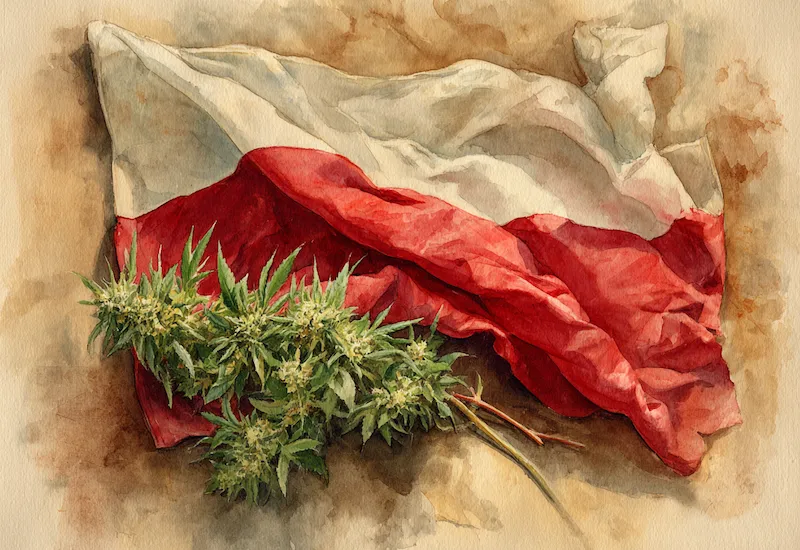
CBD Legal Requirements in Poland (2025)
CBD is legal in Poland, if it meets three conditions:
-
Derived from EU-approved hemp varieties,
-
Grown under ≤ 0.3% THC conditions during cultivation, and
-
Formulated into finished products with THC levels that do not exceed 0.2%.
This distinction is important:
-
The 0.3% THC limit applies to hemp grown for industrial or pharmaceutical use.
-
The 0.2% THC threshold is widely expected for consumer-facing CBD products to avoid classification as a narcotic under Polish law.
Quick Summary of THC Limits in Poland
| Stage | Legal THC Limit | Notes |
|---|---|---|
| Hemp cultivation | ≤ 0.3% | As of May 2022 amendment to Polish drug laws |
| Retail CBD products (all types) | ≤ 0.2% | For safety and narcotic control; |
| Medical/pharmaceutical use | Special case via prescription | Subject to pharmacy compounding laws |
CBD in Food Supplements
CBD is not formally authorized for sale as a food or dietary supplement in Poland unless it complies with the EU Novel Food Regulation (EU) 2015/2283. According to this regulation:
-
CBD isolate and purified extracts are considered novel foods.
-
They require pre-market approval by the European Food Safety Authority (EFSA) before legal sale.
Extraction Method Matters
-
Modern methods such as CO₂ or ethanol extraction often produces purified CBD extracts that are classified as novel foods under EU rules.
-
Cold-pressed hemp extracts are sometimes argued to be outside Novel Food scope, but in practice, Polish authorities rarely accept them for ingestible products. THC must be non-detectable, and sourcing must be clearly documented.
Enforcement Reality
Many CBD oils and supplements on the market today operate in a legal grey area. GIS (Główny Inspektorat Sanitarny – Chief Sanitary Inspectorate) has removed non-compliant products from store shelves and online platforms, particularly when:
-
THC exceeded 0.2%,
-
Products were improperly labeled, or
-
No Novel Food clearance existed.
CBD in Cosmetic Products

CBD is legal for use in cosmetics in Poland, in line with the EU Cosmetics Regulation (EC No. 1223/2009), but with important restrictions:
-
CBD must not be derived from the flowering tops of the plant.
-
THC content must be below 0.2% or undetectable.
-
Claims must not imply therapeutic or medicinal effects.
Most compliant CBD cosmetics in Poland use CBD isolate or purified distillate from approved hemp strains. Proper sourcing and laboratory verification are essential to avoid regulatory pushback. At Hempo Solutions, all cosmetic products are formulated under ISO 22716 (Cosmetics GMP) conditions, using purified cannabinoids to ensure full compliance with EU regulations. We’ve found that relying on non-floral sources and maintaining THC below detectable limits is the most consistent path to safe and scalable cosmetic formulations.
Medical Use of CBD in Poland
Since 2017, medical cannabis has been legal in Poland under prescription. While CBD itself is not classified as a registered pharmaceutical, it can be included in pharmacy-compounded medications, known as magistral preparations.
Only physicians with appropriate licenses can prescribe cannabis-based treatments. These must be compounded by licensed pharmacies, following pharmaceutical-grade quality and labelling standards. Off-label use of CBD, for issues like anxiety or pain, is legally permitted, but such products cannot be advertised or marketed for medical purposes.
Selling CBD Products Online in Poland
Yes, online CBD sales are legal in Poland – but only for products that comply with THC, Novel Food, and labelling regulations. This applies equally to Polish and foreign e-commerce operators shipping into Poland.
Compliance Checklist:
-
Lab reports (COAs) must prove THC content is under 0.2%.
-
Product categories must be accurately labeled (e.g., “cosmetic” vs. “dietary supplement”).
-
No health or therapeutic claims are allowed unless the product is registered as a medicine.
Authorities such as GIS (Chief Sanitary Inspectorate) and UOKiK (Office of Competition and Consumer Protection) actively monitor websites and can issue takedown orders, fines, or bans for non-compliant marketing.
Hemp Cultivation & CBD Extraction in Poland

Farmers can legally grow hemp in Poland if they use approved seed varieties and register their crops. THC must stay below 0.3% throughout cultivation.
However, CBD extraction is a different legal category and far more regulated. Businesses must obtain licenses, comply with processing laws, and submit to inspections. Any extract containing more than 0.2% THC is considered a narcotic under Polish law.
Imports of CBD isolate or raw material also fall under customs control and require lab reports and documentation to pass inspection.
Who Regulates CBD in Poland?
Poland does not have a single unified law for CBD. Instead, regulations fall under a complex patchwork of EU directives and national legislation. The key regulatory bodies include:
-
GIS – Food supplements, cosmetics, labeling, safety
-
GIF – Medical cannabis and pharmacy regulations
-
UOKiK – Consumer protection and advertising
-
Customs Office – Import/export and narcotics control
-
Ministry of Agriculture – Hemp cultivation permits and seed compliance
From our own experience navigating compliance across multiple EU countries, the best approach is proactive coordination. Businesses should ensure that each product category – whether food, cosmetic, or medical – has all the required documentation ready for inspection. This includes COAs, ingredient traceability, label translations, and, where applicable, Novel Food or CPNP registration proof. Partnering with a CBD manufacturer who understands these layered requirements can significantly reduce the risk of product removals or fines.
Public Sentiment and Market Outlook
CBD has become more socially accepted in Poland over the past decade. While THC still carries stigma, CBD is increasingly viewed as a wellness tool for sleep, anxiety, and stress relief. Public education and clearer laws have helped grow the market, but confusion around legality remains a hurdle.
As awareness increases and EU standards evolve, Poland’s CBD market is expected to keep expanding. Brands that lead with transparency, third-party testing, and proper compliance will earn the most trust.
Conclusion: Is CBD Legal in Poland in 2025?
Yes – CBD is legal in Poland, but the rules are complex and strictly enforced. Whether you’re a manufacturer, importer, retailer, or consumer, the same principle applies: stay compliant or risk penalties.
Compliance Checklist (for businesses):
✔️ Use EU-approved hemp varieties
✔️ Ensure THC content is:
-
≤ 0.3% for raw hemp
-
≤ 0.2% (or non-detectable) for consumer products
✔️ Don’t sell food/supplements unless Novel Food approved.
✔️ Don’t source CBD from flowering tops for cosmetics.
✔️ Provide batch-specific lab tests (COAs) showing:
-
Cannabinoid profile
-
THC below legal limits
-
No harmful contaminants
✔️ Avoid health claims unless registered as a medicine.
✔️ Ensure Polish-language compliance documentation is complete and current.